اقْرَأْ بِاسْمِ رَبِّكَ الَّذِي خَلَقَ
Read in the light of revelation
Adab Reader is a browser extension. When allowed, it reads whatever you're reading. And responds live, drawing from fourteen centuries of classical Islamic scholarship.
Free. No account.
Examples of how Adab Reader responds
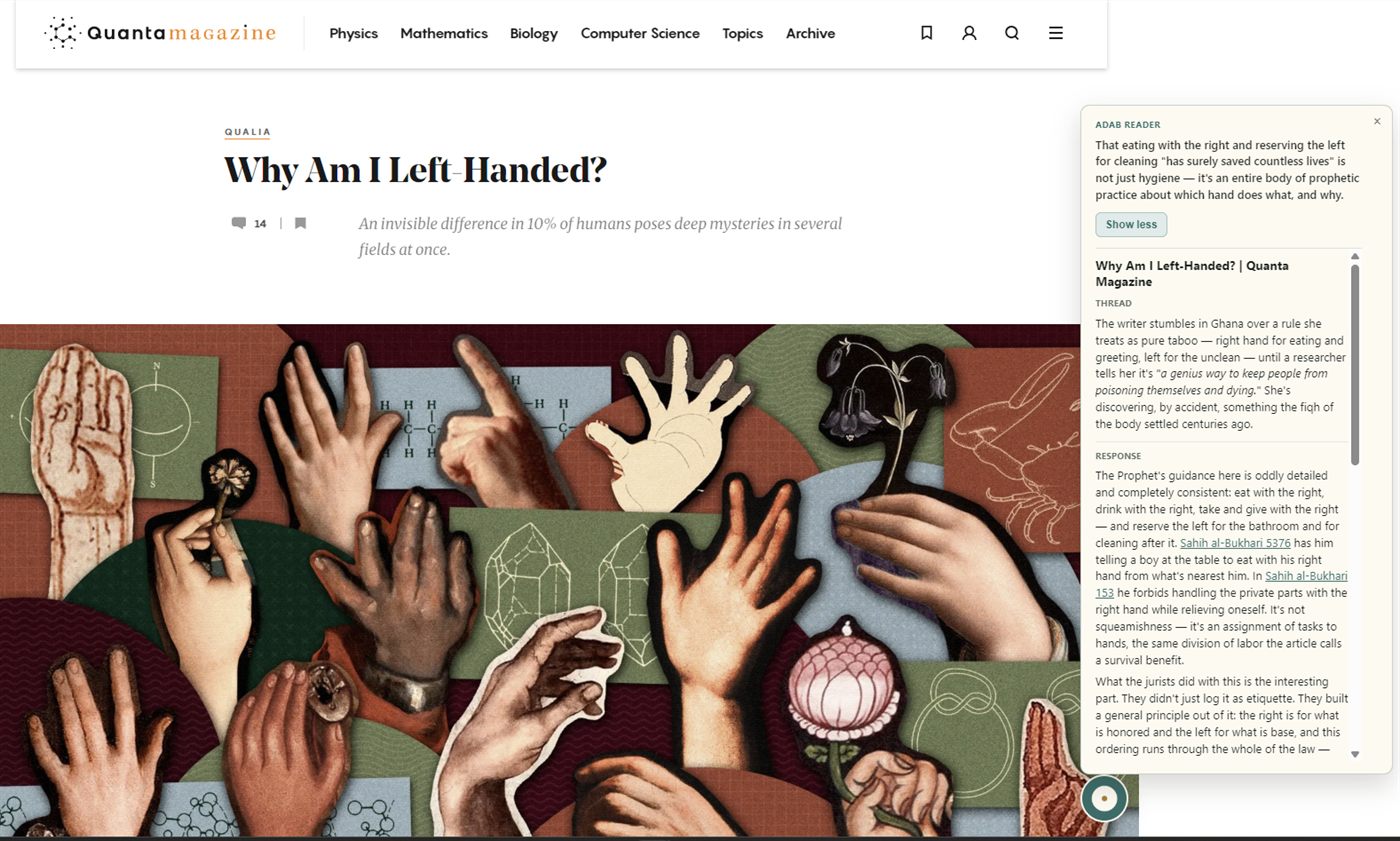
Quanta Magazine · Why am I left-handed?
That eating with the right and reserving the left for cleaning “has surely saved countless lives” is not just hygiene — it's an entire body of prophetic practice about which hand does what, and why.
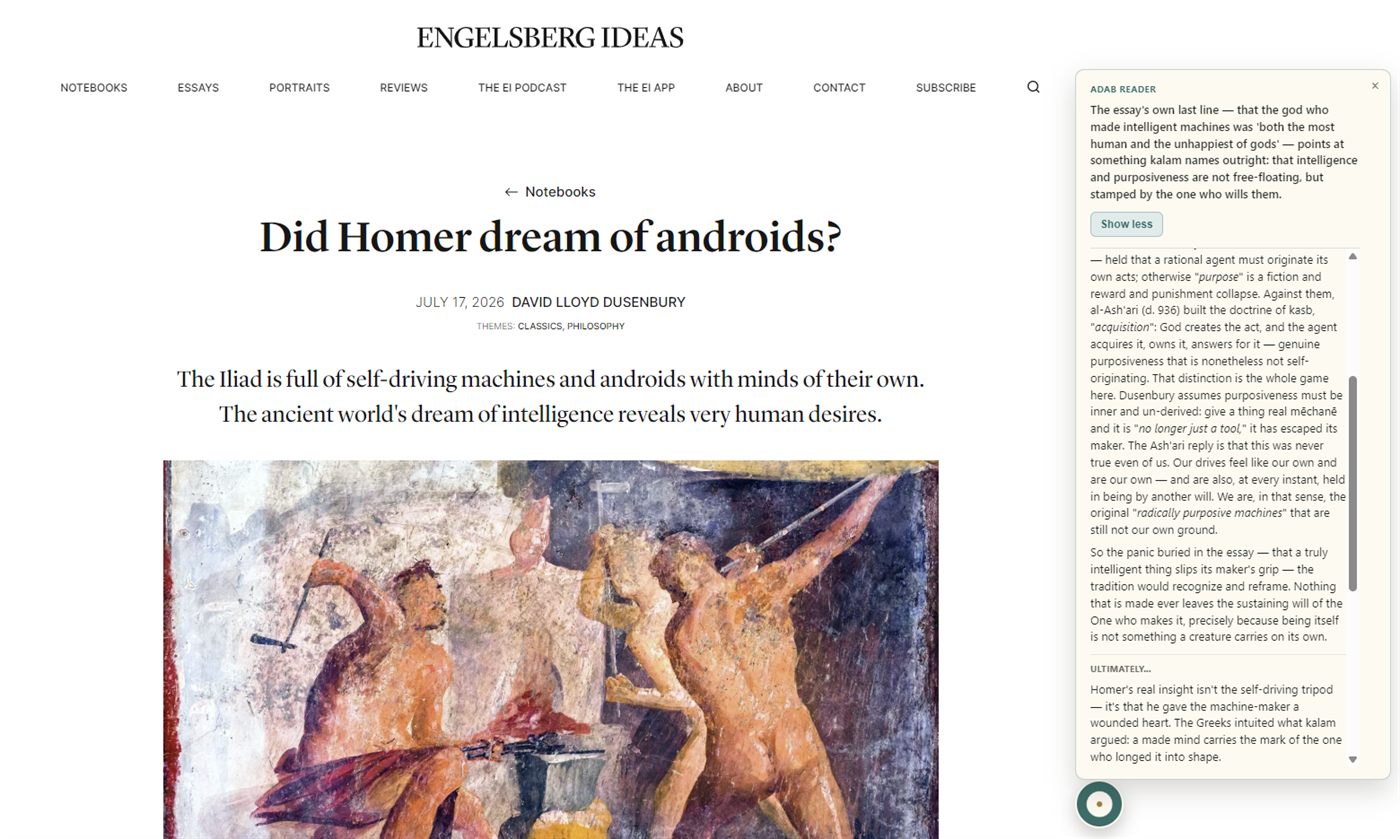
Engelsberg Ideas · Did Homer dream of androids?
The essay's own last line — that the god who made intelligent machines was ‘both the most human and the unhappiest of gods’ — points at something kalam names outright: that intelligence and purposiveness are not free-floating, but stamped by the one who wills them.
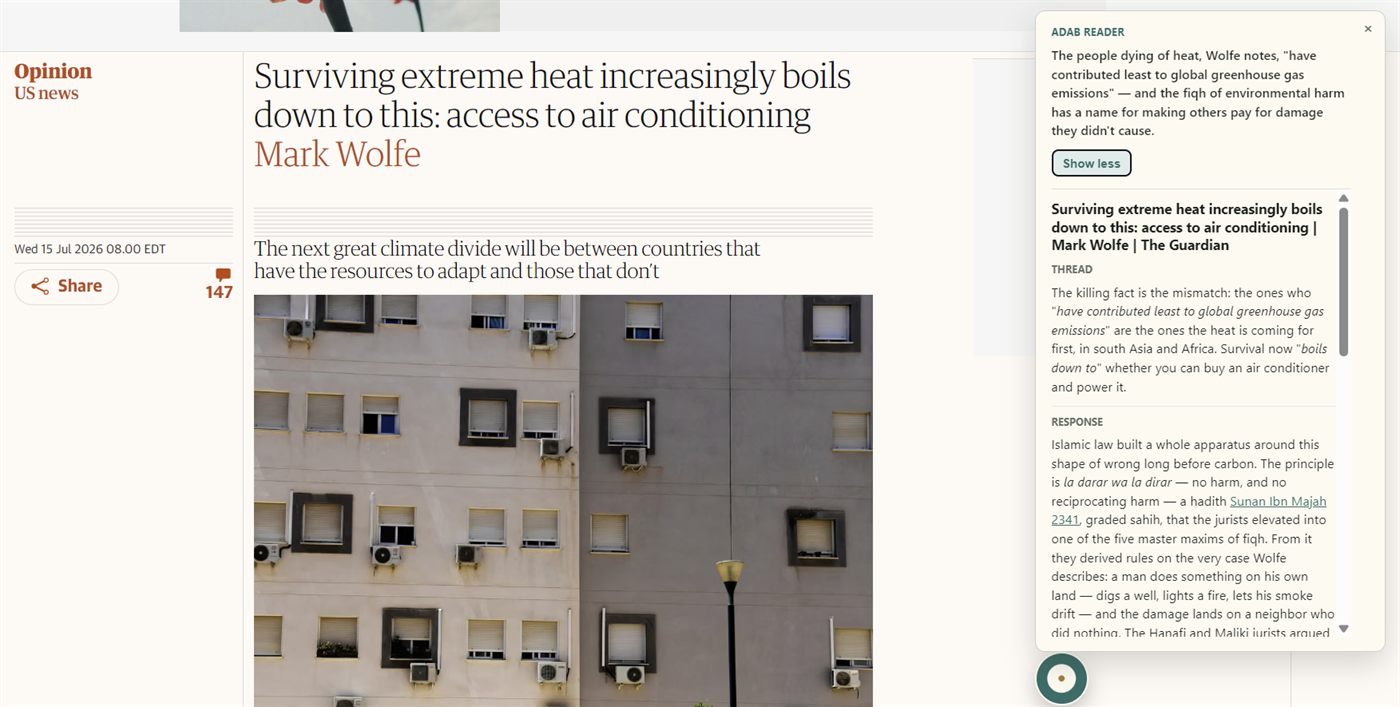
The Guardian · Surviving extreme heat comes down to air conditioning
The people dying of heat, Wolfe notes, “have contributed least to global greenhouse gas emissions” — and the fiqh of environmental harm has a name for making others pay for damage they didn't cause.
Read one of them in full — Did Homer dream of androids?
…to build a machine with mind is to build “a radically purposive machine” that “has its own imperatives and objectives, its own drives.”
Adab Reader
The essay's closing claim — that a truly intelligent machine ‘cannot and will not be exhaustively instrumentalised by its creators’ because intelligence carries its own purposiveness — runs straight into the kalam debate over whether any created thing can act on its own power at all.
Thread
Dusenbury's argument lands on a genuine metaphysical claim, not a literary one: to build a machine with mind is to build "a radically purposive machine" that "has its own imperatives and objectives, its own drives" — an intelligence its makers cannot fully own. Homer's golden girls with "intelligence... in their hearts" become the test case.
Response
The Muslim theologians fought exactly this out, and hard. The Mu'tazila — the early rationalist school — held that human beings genuinely originate their own acts; God gives the power, but the deed is truly yours, or else reward and punishment make no sense. The Ash'aris, following al-Ash'ari in the 10th century, recoiled: nothing in creation has independent causal power at all. What looks like fire burning cotton is really God creating the burning at the moment of contact, habit fooling us into calling it cause. Al-Ghazali pressed this to its edge in the Tahafut al-Falasifa, his demolition of the philosophers — the link between cause and effect, he wrote, is not necessary; God could create the effect without the cause any time He wills.
Hold Dusenbury's android up to that and something turns over. He assumes intelligence smuggles in real, irreducible purposiveness — a drive the maker can't reclaim, whether "violent like the Cyclops" or "attentive like Hephaestus' girls." The Ash'ari would say that's the same illusion as the burning cotton. A manufactured mind, however dense its behavior, borrows every flicker of its agency moment to moment from the only will that actually originates anything. It would have mechane, cunning — but cunning is not the same as autonomy. The Greeks blurred them. The theologians spent centuries prying them apart.
Ultimately…
The real question the essay circles isn't whether a machine could have drives we don't control, but whether anything created — us included — ever originates a drive of its own. The Greeks never had to ask it that starkly, because they never had a Creator who holds every atom in being at every instant.
This appears in the corner of your screen within a minute of opening a piece.
Try it on one article
Paste a link, drop a file, or drop in some text. No extension needed.
Free your Islam from the ghetto of your own mind.
Our Islam too often lives in a small, deracinated corner of our minds. A ghetto of sorts. Prayer, Ramadan, the du'a before travel — they tend to happen in this musty old backroom, while the rest of our intellectual and professional lives occur elsewhere, in airy, sunlit, socially vibrant, and critically responsive spaces.
Which is a shame. Because kalam, fiqh, tafsir, tasawwuf, the sira, are all powerful working instruments. Any serious question — scientific, civic, cultural, or aesthetic — is invariably illuminated and clarified in their light.
Pious and thoughtful Muslims take rightful pride in the products, the outputs — from algebra, to optics, to the astrolabe — of the Islamic golden age. But we reflect less on the actual cognitive assumptions of believing men and women devoted to uncovering God's ilm. How their niyyah (intention), curiosity, wonder, and rigor operated within an ethical frame situated in the Qur'an and the hadith.
What Ibn Sina brought to medicine in the 11th century and Ibn Rushd brought to philosophy in the 12th, you can bring to ethics, politics, science and culture in the 21st.
Every microsecond, God recreates and revivifies the world anew — there's haqq (truth, reality) staring at you in the science section of today's newspaper, in a good new novel, in good television and film, if you have the basira (insight, discernment) to see it.
By explicitly connecting what's on your screen with fourteen centuries of Islamic scholarship, Adab Reader shows you how every atom, and every idea, in the universe is currently and continuously glorious.
— Aziz Lalljee
This, like each of us, is a work in progress. Questions, corrections, or concerns: contact@adabreader.com.
Method
How a reading is made, how to switch it off, what leaves your browser, what it draws on, and where it fails.
How it responds
- The page is checked for article metadata, or failing that, for enough paragraphs of continuous prose. Pages with a visible password field are skipped.
- The body text is extracted and truncated.
- The text and a system prompt are sent to Claude Opus 4.8 (Anthropic). There is no separate Islamic database behind it: hadith wording,1 Qur'anic verses, and classical references come from the model's training.
- The reading appears in the panel and is cached in your browser, so returning to the same article does not generate it again.
Which discipline
A reading typically works in just one discipline — kalam, fiqh, or tasawwuf. Qur'anic verses and hadith are cited inside whichever of the three applies.
- Kalam
- Theological reasoning. For pieces whose weight is God, creation, providence, meaning, evil, suffering, dignity, or the grounds of value.
- Fiqh
- Legal and ethical inquiry. Named categories, rulings, and maxims — obligation, harm, ownership, entitlement.
- Tasawwuf
- Spiritual psychology. For pieces about attention, motive, character, envy, desire, distraction, sincerity, or how a person is formed by what they consume.
Turning it off
The toolbar icon opens two switches. Read pages as I browse stops the extension everywhere while leaving it installed. Pause on this site stops it on the site you are currently on and leaves the rest alone; paused sites are remembered until you switch them back on. With either off, no page text leaves your browser.
What is sent and stored
Generating a reading sends the article's text to Anthropic's Claude API, for that request only and not for training. Nothing is sent for pages you do not read, for pages that fail the article check, or while the extension is off or paused.
There are no accounts. On first run the extension generates a random installation ID, which is sent with each request so free readings can be counted. The server stores that ID and a number, and deletes the record a year after your last reading. No article text, URL, or browsing history is stored against it. Clearing browser storage clears the ID. Readings themselves are cached only in your own browser unless you press Share, which is opt-in and stores that one reading so its link works. Full detail is in the privacy policy.
Sources
Qur'an and tafsir
- Al-Tabari — Jami' al-Bayan 'an Ta'wil ay al-Qur'an
- Al-Zamakhshari — Al-Kashshaf
- Fakhr al-Din al-Razi — Mafatih al-Ghayb
- Al-Qurtubi — Al-Jami' li-Ahkam al-Qur'an
- Ibn Kathir — Tafsir al-Qur'an al-'Azim
Hadith collections
- Sahih al-Bukhari
- Sahih Muslim
- Sunan Abi Dawud
- Jami' at-Tirmidhi
- Sunan an-Nasa'i
- Sunan Ibn Majah
- Malik ibn Anas — Al-Muwatta
- Al-Nawawi — Riyad al-Salihin, Al-Arba'in
Hadith criticism and commentary
- Ibn al-Salah — Muqaddima ('Ulum al-Hadith)
- Ibn Hajar al-'Asqalani — Fath al-Bari
- Al-Nawawi — Sharh Sahih Muslim
- Al-Bayhaqi — Al-Sunan al-Kubra
Usul al-fiqh
- Al-Shafi'i — Al-Risala
- Al-Juwayni — Al-Burhan fi Usul al-Fiqh
- Al-Ghazali — Al-Mustasfa min 'ilm al-usul
- Al-Sarakhsi — Usul al-Sarakhsi
- Ibn Qudama — Rawdat al-Nazir
- Al-Shatibi — Al-Muwafaqat
Fiqh and legal maxims
- Ibn Rushd — Bidayat al-Mujtahid
- Al-Suyuti — Al-Ashbah wa'l-Naza'ir
- Ibn Nujaym — Al-Ashbah wa'l-Naza'ir
- Al-Mawardi — Al-Ahkam al-Sultaniyya
Kalam
- Al-Ash'ari — Al-Ibana 'an Usul al-Diyana
- Al-Maturidi — Kitab al-Tawhid
- Al-Baqillani — Al-Tamhid
- Al-Juwayni — Kitab al-Irshad
- Al-Ghazali — Al-Iqtisad fi al-I'tiqad, Tahafut al-Falasifa
- Fakhr al-Din al-Razi — Al-Matalib al-'Aliya
- Al-Nasafi — Al-'Aqa'id al-Nasafiyya
- Al-Taftazani — Sharh al-'Aqa'id al-Nasafiyya
Tasawwuf
- Al-Muhasibi — Al-Ri'aya li-Huquq Allah
- Al-Sulami — Tabaqat al-Sufiyya
- Al-Qushayri — Al-Risala al-Qushayriyya
- Al-Ghazali — Ihya 'Ulum al-Din (overview)
- Abd al-Qadir al-Jilani — Futuh al-Ghayb
- Ibn Ata'illah al-Iskandari — Al-Hikam
- Ibn Arabi (selected texts)
Akhlaq and adab
- Ibn Miskawayh — Tahdhib al-Akhlaq
- Al-Mawardi — Adab al-Dunya wa'l-Din
- Al-Ghazali — Mizan al-'Amal
Sira
- Ibn Ishaq / Ibn Hisham — Al-Sira al-Nabawiyya
- Al-Waqidi — Kitab al-Maghazi
- Ibn Sa'd — Al-Tabaqat al-Kubra
- Qadi Iyad — Al-Shifa
Philosophy and the sciences
- Al-Kindi — On First Philosophy
- Al-Farabi — Ara' Ahl al-Madina al-Fadila
- Ibn Sina — Al-Shifa, Al-Qanun fi'l-Tibb
- Ibn al-Haytham — Kitab al-Manazir
- Al-Biruni — Tahqiq ma li'l-Hind
- Ibn Rushd — Fasl al-Maqal, Tahafut al-Tahafut
- Ibn Khaldun — Al-Muqaddima
Names of Allah
- Al-Ghazali — Al-Maqsad al-Asna
- AYEINA referenced list
- Yaqeen Institute, on the pairing of Names
Contemporary
The Names of Allah — full catalog
The set a reading can draw from. The Names are treated as revealed knowledge rather than a free-form symbol set, and are used only where one is genuinely manifest in the piece.
Limits
A reading is not remotely a fatwa, does not replace a teacher, and does not rule on anyone's situation.
- Citations can be wrong. The engine reproduces hadith wording and references from training, not from a verified database. Attributions and numbering are usually right and are not guaranteed. Check any citation against the collection before relying on it or repeating it.
- Nothing is authenticated here. A reading may state a grading; it has not examined an isnad. The grading is reported, not established.
- One reading is one thread. The engine picks a single discipline and a single line through the piece. A second pass on the same article will often find a different one, equally available.
- It only sees what it extracted. Text behind a paywall, in images, or past the truncation limit is not read. The response is to the portion it received.
- The frame is Sunni and classical. The sources above are Sunni; the register follows Ash'ari and Maturidi kalam and the four Sunni schools. Other traditions are not represented.
Notes
- Citations are limited to the six canonical Sunni collections: Sahih al-Bukhari, Sahih Muslim, Sunan Abi Dawud, Jami' at-Tirmidhi, Sunan an-Nasa'i, Sunan Ibn Majah. Bukhari and Muslim are cited first. The other four are cited only where the narration is sahih or hasan, and the grading is stated in the text. A verse or hadith whose wording is not confidently known is omitted rather than approximated. ↩
This is a working project. A reading that is thin, wrong, or overreaching is useful to know about: contact@adabreader.com.